
"DID YOU KNOW?" will be a summer series where we review issues of the Bible and the Christian faith of special interest. If you have a suggestion/question that you'd like addressed in a "DID YOU KNOW?" segment, please e-mail the coaches.
Where did the word "Christian" come from?
Nowadays, Christ-followers all over the world are called "Christians". It's so common that we don't even question the meaning of the word. Our religion is "Christianity" and so we are called "Christians".
But it is not what early believers called themselves. In Acts, we see the Apostles and earliest followers of Christ referring to their religion as "The Way" and themselves as "Followers of the Way." In fact, the earliest uses of the term "Christian" are not by believers, but their opponents (Acts 11:26 & Acts 26:28). And only in 1 Peter 4:16 - written between 60 and 100 A.D. when he was an old man - does a writer of scripture use the term in a positive light.
"Christian" literally means "little Christ". It was intended as an insult. But early believers, after initially disliking the term, decided to embrace it as their own. After all, in the end, what we all want is to be "little Christs" - people striving to be like Jesus in our world, to show humanity the love of God.
Showing posts with label language. Show all posts
Showing posts with label language. Show all posts
Monday, June 15, 2015
Monday, June 02, 2014
 DID YOU KNOW: Where did the word "Christian" come from?
"DID YOU KNOW?" will be a summer series where we review issues of the Bible and the Christian faith of special interest. If you have a suggestion/question that you'd like addressed in a "DID YOU KNOW?" segment, please e-mail the coaches.
Where did the word "Christian" come from?
Nowadays, Christ-followers all over the world are called "Christians". It's so common that we don't even question the meaning of the word. Our religion is "Christianity" and so we are called "Christians".
But it is not what early believers called themselves. In Acts, we see the Apostles and earliest followers of Christ referring to their religion as "The Way" and themselves as "Followers of the Way." In fact, the earliest uses of the term "Christian" are not by believers, but their opponents (Acts 11:26 & Acts 26:28). And only in 1 Peter 4:16 - written between 60 and 100 A.D. when he was an old man - does a writer of scripture use the term in a positive light.
"Christian" literally means "little Christ". It was intended as an insult. But early believers, after initially disliking the term, decided to embrace it as their own. After all, in the end, what we all want is to be "little Christs" - people striving to be like Jesus in our world, to show humanity the love of God.
Where did the word "Christian" come from?
Nowadays, Christ-followers all over the world are called "Christians". It's so common that we don't even question the meaning of the word. Our religion is "Christianity" and so we are called "Christians".
But it is not what early believers called themselves. In Acts, we see the Apostles and earliest followers of Christ referring to their religion as "The Way" and themselves as "Followers of the Way." In fact, the earliest uses of the term "Christian" are not by believers, but their opponents (Acts 11:26 & Acts 26:28). And only in 1 Peter 4:16 - written between 60 and 100 A.D. when he was an old man - does a writer of scripture use the term in a positive light.
"Christian" literally means "little Christ". It was intended as an insult. But early believers, after initially disliking the term, decided to embrace it as their own. After all, in the end, what we all want is to be "little Christs" - people striving to be like Jesus in our world, to show humanity the love of God.

Monday, July 08, 2013
DID YOU KNOW: Where did the word "Christian" come from?
"DID YOU KNOW?" will be a summer series where we review issues of the Bible and the Christian faith of special interest. If you have a suggestion/question that you'd like addressed in a "DID YOU KNOW?" segment, please e-mail the coaches.
Where did the word "Christian" come from?
Nowadays, Christ-followers all over the world are called "Christians". It's so common that we don't even question the meaning of the word. Our religion is "Christianity" and so we are called "Christians".
But it is not what early believers called themselves. In Acts, we see the Apostles and earliest followers of Christ referring to their religion as "The Way" and themselves as "Followers of the Way." In fact, the earliest uses of the term "Christian" are not by believers, but their opponents (Acts 11:26 & Acts 26:28). And only in 1 Peter 4:16 - written between 60 and 100 A.D. when he was an old man - does a writer of scripture use the term in a positive light.
"Christian" literally means "little Christ". It was intended as an insult. But early believers, after initially disliking the term, decided to embrace it as their own. After all, in the end, what we all want is to be "little Christs" - people striving to be like Jesus in our world, to show humanity the love of God.
Where did the word "Christian" come from?
Nowadays, Christ-followers all over the world are called "Christians". It's so common that we don't even question the meaning of the word. Our religion is "Christianity" and so we are called "Christians".
But it is not what early believers called themselves. In Acts, we see the Apostles and earliest followers of Christ referring to their religion as "The Way" and themselves as "Followers of the Way." In fact, the earliest uses of the term "Christian" are not by believers, but their opponents (Acts 11:26 & Acts 26:28). And only in 1 Peter 4:16 - written between 60 and 100 A.D. when he was an old man - does a writer of scripture use the term in a positive light.
"Christian" literally means "little Christ". It was intended as an insult. But early believers, after initially disliking the term, decided to embrace it as their own. After all, in the end, what we all want is to be "little Christs" - people striving to be like Jesus in our world, to show humanity the love of God.
Tuesday, August 10, 2010
 Computer Program Decodes Ancient Language
While we know a lot about Biblical Hebrew, Greek, and Aramaic, there remain many languages of the time of the Patriarchs that are beyond our ability to decipher. It is not necessarily that these languages are excessively complex, but rather that we have no frame of reference to match shapes to sounds or ideas. It's like trying to read your little brother's chicken-scratch without knowing if he was leaving a note about lunch, school, or that strange smell in the basement.
But now, a simple program has done in a few hours what linguists took years to do - it has decoded Ugaritic, a language used during the Biblical times.
But now, a simple program has done in a few hours what linguists took years to do - it has decoded Ugaritic, a language used during the Biblical times.
The MIT team was able to decode the "lost language" of Ugaritic, an ancient Semitic language used in Old Testament times, using no more computing power than that of a laptop. The program took no longer than a few hours to link most Ugaritic symbols to their Hebrew equivalents.This raises the possibility that other Bible-era languages could also be unlocked with enhanced versions of this program. One day, we may have confirmation of the miracles of Israel from the mouths of other nations and peoples.
Ugaritic text was nothing more than a series of dots and wedge-shaped marks to linguists and scholars when it was first discovered on clay tablets in 1928, excavated from the rubble of the ancient city of Ugarit by French archaeologists. Even though the language is closely related to Hebrew, experts did not decipher it until 1932.
Monday, July 27, 2009
 "Find a Bible"
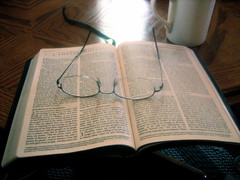 It is easy to find an English Bible. We have many translations, paraphrases, interlinears, etc. In fact, we have so many different kinds of Bibles that for Quizzing, we have to specify the exact translation to use (NIV, not TNIV or ESV or KJV). But that is not the case for many others whose language is not one of the majority. So, what do you do if your first language is not English, and you can't read 1st-century Greek? The Forum of Bible Agencies has introduced "Find a Bible", a new interactive website for locating translations and resources (online or otherwise) for virtually any language the translators have gotten to. Click on over and check it out. It is amazing to see just how many languages it covers for the USA alone!
Tuesday, July 14, 2009
 Hand-Inscribed Bibles in 100 Languages
Most of the Bibles that we see are printed by machines. A few of us who are lucky may see an illuminated manuscript from the Middle Ages. Now, the Bible Valley Society is working from Jerusalem to produce 100 hand-inscribed Bibles written in 100 languages.
To date, thousands of people from 31 countries have participated in the project, dubbed "People of the World Inscribe the Bible."
Accord to organizers' plans, each community hand-inscribes the 23,127 verses of the Jewish Bible, with the goal being to inscribe 100 Bibles in 100 languages.
Among the 31 countries represented so far are Panama, Costa Rica, Brazil, the United States, Argentina, Denmark, India, Hong Kong, Taiwan, Greece, Israel, Poland, Singapore, Finland, Canada, Britain, Germany, Switzerland, Latvia and Ukraine.
Subscribe to:
Posts (Atom)