Home of the Trumbull, CT EFCA Bible Quiz Team.

The Trumbull Bible Quiz Team has ended. Thank you for 30 years of happy Bible Quizzing.
Showing posts with label archeology. Show all posts

Sunday, November 01, 2015

BIBLE NEWS: Earliest draft of the KJV found

While we use the NIV translation of the Bible for our quizzing, the King James Version (KJV) remains an essential resource and a key touchpoint for English translations of the Bible.  A new discovery was recently made of the oldest handwritten draft of the King James Bible every found!
While very few drafts — and no complete drafts — of the King James version have been found, Miller’s discovery is the first that can be attributed to a particular translator. Further study, he said, will shed light on the KJV, but also the English language it helped shape.
“The King James Bible is a monument of English religion, literature and the language itself,” he said, and it’s important to understand how it got built.

Saturday, May 10, 2014

BIBLE NEWS: Archeologist finds David's Water Tunnel

Since the start of modern archeology, scientists and historians have debated whether it made sense to use the Bible as a guide to finding ancient sites.  Some skeptics dismiss the historicity of the Bible entirely due to its use as a religious document.  Others believe that the Bible recounts history.

An Israeli archeologist may have bolstered the "Bible as history" argument by discovering the water tunnel that David used to conquer Jerusalem.
In the second Book of Samuel, David orders the capture of the walled city by entering it through the water shaft. Shukron's excavation uncovered a narrow shaft where spring water flowed into a carved pool, thought to be where city inhabitants would gather to draw water. Excess water would have flowed out of the walled city through another section of the shaft Shukron said he discovered — where he believes the city was penetrated.

Wednesday, July 17, 2013

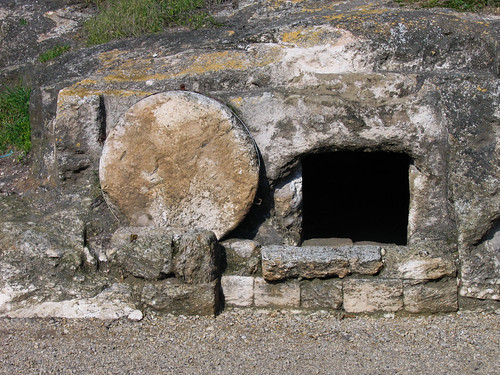
PHOTO OF THE WEEK: A Tomb like Jesus Was Laid In

Have you ever wondered what the tomb that Jesus was laid in on Good Friday looked like?  This isn't the same one, but gives you a good idea of how it may have looked.

Not Jesus' tomb, but a tomb none the less.

Saturday, July 13, 2013

BIBLE NEWS: Ancient alphabetical inscription discovered in Jerusalem

An ancient earthenware jar has been found in Jerusalem which contains the oldest alphabetical language inscription ever discovered in the region.  In general, there are two kinds of written language.  Alphabetical languages encode the sounds we make as letters - like the English alphabet.  Pictographic languages encode meaning into pictures which represent whole words - like Egyptian hieroglyphics.
Working near the Temple Mount, head archaeologist Eilat Mazar uncovered the 10th century B.C.E inscription, engraved on a large pithos, a necklace ceramic jar, along with six others at the Ophel excavation site.
The inscription is written in the Canaanite language, a Biblical people who lived in the present-day Israel, and is the only of its kind to be found in Israel. The artifact predates the previously oldest inscription found in the area by 250 years and predates the Biblical Israelites' rule.

Tuesday, August 10, 2010

Computer Program Decodes Ancient Language

While we know a lot about Biblical Hebrew, Greek, and Aramaic, there remain many languages of the time of the Patriarchs that are beyond our ability to decipher. It is not necessarily that these languages are excessively complex, but rather that we have no frame of reference to match shapes to sounds or ideas. It's like trying to read your little brother's chicken-scratch without knowing if he was leaving a note about lunch, school, or that strange smell in the basement.

But now, a simple program has done in a few hours what linguists took years to do - it has decoded Ugaritic, a language used during the Biblical times.
The MIT team was able to decode the "lost language" of Ugaritic, an ancient Semitic language used in Old Testament times, using no more computing power than that of a laptop. The program took no longer than a few hours to link most Ugaritic symbols to their Hebrew equivalents.

Ugaritic text was nothing more than a series of dots and wedge-shaped marks to linguists and scholars when it was first discovered on clay tablets in 1928, excavated from the rubble of the ancient city of Ugarit by French archaeologists. Even though the language is closely related to Hebrew, experts did not decipher it until 1932.
This raises the possibility that other Bible-era languages could also be unlocked with enhanced versions of this program. One day, we may have confirmation of the miracles of Israel from the mouths of other nations and peoples.

Tuesday, February 23, 2010

3000 year old wall from the era of Solomon

Archeology has been a source of constant comfort for the Christian apologist. Every time an archeologist has set out to disprove a record from the Bible, they have failed. Now, a new discovery of a 3000 year old wall from the time of Solomon attests to the strong, rich government of Israel's wisest king.
Speaking to reporters at the site Monday, Mazar, from the Hebrew University of Jerusalem, called her find "the most significant construction we have from First Temple days in Israel."

"It means that at that time, the 10th century, in Jerusalem there was a regime capable of carrying out such construction," she said.
It will be interesting to see what else can be found alongside this wall. We may learn many things about the times of David and Solomon.

Wednesday, January 13, 2010

Pre-Abraham settlement found in Israel

Archeologists recently announced the discovery of an 8,000 year old building in Tel Aviv complete with tools from the era, indicating the earliest evidence of humans living in the area. It is worth noting that historians believe the patriarch Abraham lived about 2000 BC, so this settlement predates him by about 2000 years.
"This discovery is both important and surprising to researchers of the period," said Ayelet Dayan, the archaeologist who led the excavation. "For the first time we have encountered evidence of a permanent habitation that existed in the Tel Aviv region 8,000 years ago," she said...
The remains were found near the Ayalon river which Dayan said probably influenced the ancient dwellers' decision to settle.
Pottery shards found at the site helped archaeologists date the building.

Tuesday, November 17, 2009

Israel displays coins from the destruction of the Temple

One of the least popular of Jesus's sayings were his prophecies about the destruction of the Temple. It was still in place during his crucifixion and Resurrection, but the Temple was destroyed by the Romans about 70 A.D. Now, Israel is displaying coins that survived the destruction and discussing what it tells us about 1st century Jerusalem.
The coins were excavated from an ancient street below the Temple Mount, experts said. Archaeologists had to sift through debris and remove boulders thrown off the Temple Mount during the Roman raid before they found the road and the hoard of coins...

The coins are part of a larger exhibition in Jerusalem's Archaeological Garden, showing a collection of antique coins that have been uncovered over the past three decades.

The exhibition shows not only coins minted in Jerusalem during the rebellion but also European, North African and Persian coins that were found around the holy site from various periods.

"This just shows the international character of the city," Katz said. "It shows the importance of Jerusalem to generations of people ... the importance of Jerusalem never faded away for Jews, Christians and Muslims," she said.

Tuesday, September 08, 2009

Fragment from the World's Oldest Bible Found in Egypt

It may surprise you to learn that we have more copies of the ancient Bible than of any other ancient book in history. But scholars agree the thousands of copies we have are not NEARLY enough as we look to reconstruct the original words that Moses and others put down. Recently, another piece of the puzzle was found as a British Academic found a new fragment of one of the oldest Bible known - the Codex Sinaiticus.
Nikolas Sarris spotted a previously unseen section of the Codex Sinaiticus, which dates from about AD350, as he was trawling through photographs of manuscripts in the library of St Catherine's Monastery in Egypt.

The Codex, handwritten in Greek on animal skin, is the earliest known version of the Bible. Leaves from the priceless tome are divided between four institutions, including St Catherine's Monastery and the British Library, which has held the largest section of the ancient Bible since the Soviet Union sold its collection to Britain in 1933.

Academics from Britain, America, Egypt and Russia collaborated to put the entire Codex online this year but new fragments of the book are occasionally rediscovered.

Wednesday, December 03, 2008

Archeologists discover tomb of King Herod

There was a time when skeptics would point to historical facts in the Bible and use it to try and disprove its accuracy. But more and more, scientists are discovering finds that prove details from the historical accounts. For example, archeologists think they have found the tomb of King Herod, the man who was king over Israel when Jesus was born.
The tomb was originally about 25 meters high, a size that excavation director Ehud Netzer said would have been appropriate to a figure of Herod's political stature, the university's Institute of Archeology said in a news release today.

Digging work has continued this year at the structure first uncovered in May 2007 at Herodium, a hilltop fortress built by Herod 15 kilometers south of Jerusalem and east of Bethlehem.

Wednesday, June 11, 2008

"World's oldest church" discovered?

Just in time for the new Indiana Jones movie, archeologists are claiming they have unearthed the world's "oldest church" in the country of Jordan. This find has not yet been analyzed by other archeologists or church history experts, but it may offer an intriguing look into the Early Church after they were scattered from Jerusalem.
"We have uncovered what we believe to be the first church in the world, dating from 33 AD to 70 AD," the head of Jordan's Rihab Centre for Archaeological Studies, Abdul Qader al-Husan, said.

He said it was uncovered under Saint Georgeous Church, which itself dates back to 230 AD, in Rihab in northern Jordan near the Syrian border.

"We have evidence to believe this church sheltered the early Christians -- the 70 disciples of Jesus Christ," Husan said.

These Christians, who are described in a mosaic as "the 70 beloved by God and Divine," are said to have fled persecution in Jerusalem and founded churches in northern Jordan, Husan added.

He cited historical sources which suggest they both lived and practised religious rituals in the underground church and only left it after Christianity was embraced by Roman rulers.
But, as always, take this news with a grain of salt. Our faith is based on the Bible and Jesus Christ, not on any particular archeological discovery.